
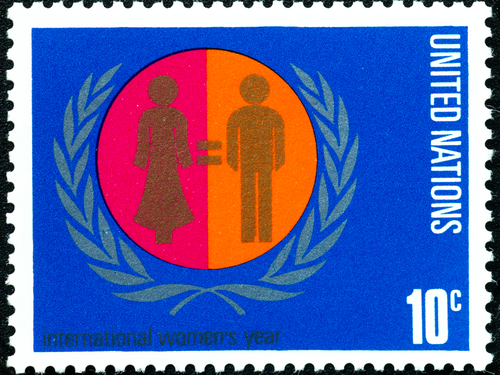
 In the midst of the Cold War and the horrific conflicts occurring throughout Asia and Africa coping with the decolonisation efforts of the 1960s and 1970s, the United Nations Commission on the Status of Women succeeded in crafting the Declaration on the Elimination of Discrimination Against Women in 1967. In 1972 the United Nations proclaimed 1975 as the International Women's Year - and the CSW began working on the organisational structures to assure the creation of CEDAW, a legally binding treaty, at the Convention level, to oversee the Elimination of Discrimination Against Women. What followed was the massive work by the UN and NGO representatives to organise four world conferences on women: Mexico City in 1975, Copenhagen in 1980, Nairobi in 1985 and Beijing in 1995.
A powerful report on this topic by Stephanie Oula, Sia Nowrojee, and Mayra Buvinic, The United Nations and the Global Women's Movement: Learning from the Past, Looking to the Future (UN Foundation, 2025), is available for download here.
This series of milestone events and more information can be gathered from the report's accompanying website: Where the Future was Built: The Story of the UN World Conferences on Women, https://www.wherethefuturewasbuilt.org/.
1975
The first UN World Conference on Women occurred in Mexico City 19 June - 2 July 1975. Delegates were joined by thousands of activists in women's rights from 133 countries. 113 (73%) of the 133 delegation leaders were women. The program included data gathered from UN member states that for the first time specifically separated data by sex. Two documents were adopted from the conference proceedings, the World Plan of Action and the Declaration of Mexico on the Equality of Women and Their Contribution to Development and Peace.
1980
The second UN World Conference on Women happened at the midpoint of the UN Decade for Women (1976-1975). While the conference in Mexico City had primarily served for consciousness raising, Copenhagen was where important networks were created and feminist research advanced. This conference took place July 14-30, 1980, in Copenhagen, Denmark. During the opening ceremony, the organisers offered the formal signing of the Convention on the Elimination of All Forms of Discrimination Against Women (CEDAW). The conference adopted a World Programme of Action (despite opposition from Australia, Canada, Israel and the U.S.) which included sections on creating women's bureaus. It also defined the roles of NGO organisations - this conference attracted 8000 NGO members - compared to 6000 at Mexico City. The Programme also established target issues that member states were to monitor.
1985
The third UN World Conference on Women took place 15-26 July 1985 in Nairobi, Kenya. Even though lesbian groups had been part of the earlier conferences, this was the first United Nations official meeting in which lesbian rights were formally presented. There were 157 countries represented. The attendees argued that the objectives of the UN Decade for Women had not achieved the goals set out in 1975. They convinced the United Nations General Assembly to conduct world surveys on women every five years in a continuing effort to follow-up on the implementation of the members' strategies for women's rights. For many, this conference served as the 'birthplace of global feminism' since in the early 1990s feminists gained visibility and shaped debates on women's issues at UN conferences.
1995
 The fourth UN Conference on Women took place 4-15 September 1995 in Beijing, China. The conference included representatives of 189 governments; and in addition to the 17,000 participants registered for the conference, an additional 30,000 activists attended the Forum. A crucial outcome for this conference was The Beijing Declaration and Platform for Action. Here the UN and its member states asserted 'women's rights as human rights.' Another important result of the conference was the Beijing Declaration of Indigenous Women, signed at the NGO Forum in the Indigenous Women's Tent. (Read more on this in the report prepared by the Ontario Native Women's Association, Thirty Years After the Beijing Declaration of Indigenous Women, March 2025.)
While the UN has not organised any further World Conferences on Women, there have been periodic reviews of the Beijing Platform for Action. These reviews and appraisals occur every five years, during the regular sessions of the Commission on the Status of Women (CSW). The thirty-year review Beijing+30 served as a highlight to the 69th session of the CSW. More details on this will be forthcoming.
To read more articles from The Circular (March-April 2026) issue 656, click on the tag below.