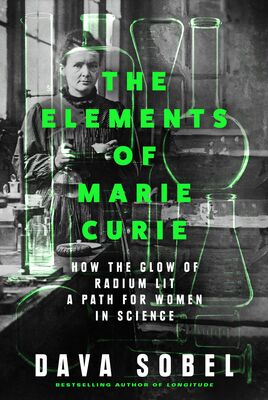
 Dava Sobel, the bestselling author of Longitude and Galileo's Daughter, offers a new biography, The Elements of Marie Curie: How the Glow of Radium Lit a Path for Women in Science. The book chronicles the life and work of the most famous woman in the history of science, and the untold story of the young women who trained in her laboratory.
Marie Curie née Skłodowska is still the only person to win a Nobel Prize in two scientific fields. Her ingenuity extended far beyond the laboratory walls; grieving the death of her husband, Pierre, she took his place as professor of physics at the Sorbonne, devotedly raised two daughters, drove a van she outfitted with x-ray equipment to the front lines of World War I; befriended Albert Einstein and inspired generations of young women to pursue science as a way of life. Many of these women including her daughter Irene, became Nobel Prize winners in their own right.
Each occasion Marie had a new advance to announce to the world, she had to beg a male colleague to present it to France’s scientific academy, which barred women from its ranks.
 Many of her laboratory workers joined the International Federation of University Women now Graduate Women International, a worldwide organisation uniting university women. They were convinced that by fostering friendship and understanding, women graduates could help prevent another catastrophe such as the World War that had just ended. This included Ellen Gleditsch, a Norwegian radiochemist and one of Marie Curie's former assistants, who served as president of the International Federation of University Women from 1926 to 1929.
Marie Curie in 1922 became a member of the Committee of Intellectual Co-operation of the League of Nations, serving until 1934. UNESCO has continued some parts of this Committee's mission. She died on 4 July 1934, and her legacy continues to shape social and scientific norms today.
To read more articles from The Circular (July-August 2025) issue 653, click on the tag below.