
 |
|
January-February 2026, Issue 655 | Action Hubs | News | GenderEqual NZ | |
Table of Contents
 |
| Suzanne Manning NCWNZ President |
President's kōrero
Kia ora, Kia Orana, Talofa, Mālō ni, and warm Pacific greetings to you all!
As we move towards International Women’s Day on 8 March, I am reflecting on how ‘international’ for NCWNZ has a good dose of ‘Polynesian region’ focus. While we add our voices to global issues, we can have more impact with a focus closer to home, by being good neighbours and supporting collective endeavours.
For example, we welcome the appointment of Rhia Taonui (a member of PACIFICA Inc) as NGO representative to accompany the NZ government delegation to CSW70 in New York in March – she will be a visible reminder that the UN is supposed to be inclusive even of those nationalities that are subject to US current travel restrictions.
We will be following with interest, and supporting when asked, the Cook Islands NCW reporting to CEDAW this year.
And we will be participating in the work being led by the Māori Women’s Welfare League, as the International Women’s Caucus (convened by the Ministry for Women) discusses how to implement Te Tiriti partnerships in the Caucus. For this last work, the Board has a mandate from the NCWNZ membership through (among other things) the 2019 Resolution that we, as an organisation, are committed to honouring Te Tiriti o Waitangi. This has been a useful Resolution that has stood the test of time. But what other types of policy are useful for us? Think about our various advocacy approaches, including submission writing, panel discussions, letter writing, and collaboration on campaigns.
The Board is working on this issue in at least two ways. One is by considering how to design policy-making sessions at this year’s Conference on September 12-13 in Manakau, Auckland-Tāmaki Makarau – how to structure them, what we want to produce from such sessions. The second way is through developing a strategy to provide coherence and coordination.
One of the starting points of the strategy was to articulate the values of NCWNZ. I particularly like the one where we agreed that “our actions are courageous”. This speaks to having NCWNZ having the courage of our convictions, and standing up for our policies in public. We showed this when Aleisha Amohia and I presented in-person to the Select Committee on the Treaty Principles Bill, a highly public event. We showed it again when Rosemary Du Plessis presented to the People’s Select Committee on Pay Equity. And again when I recently appeared at a Human Rights Tribunal hearing to explain NCWNZ’s policy on recognising the rights of trans women as women – an action that provoked backlash at both myself and NCWNZ. However the Board was well prepared for such action, we had considered that and made the decision to be courageous and publicly stand by our policies.
Being courageous comes in smaller actions as well. It shows when members gently call out disrespectful behaviour in other members. It shows when someone in an Action Hub dares to give an alternative view to enable the group to think critically about something that initially seemed ‘obvious’. These courageous actions in our midst support robust decision making and enhance our collaborative way of working.
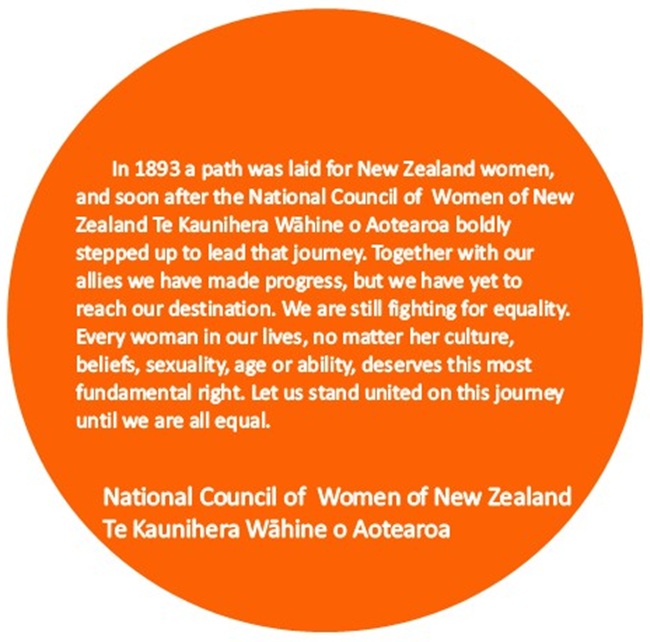
On 1 March, there will be an Art Day in Tāmaki Makaurau at the public sculpture 1001 Spheres, and if you’re in that town you might like to pop in. NCWNZ was one of the 23 Voices invited to write some words that were engraved on a disc to be installed within a sphere in 2023. A copy of this disc is now on the wall at the NCWNZ National Office in Wellington. I leave you with the inspirational words we (Carol Beaumont, Kerri Du Pont and myself) contributed to this project:
Suzanne Manning
President
Welcome our new intern, Emma Guerin
Kia ora everyone,
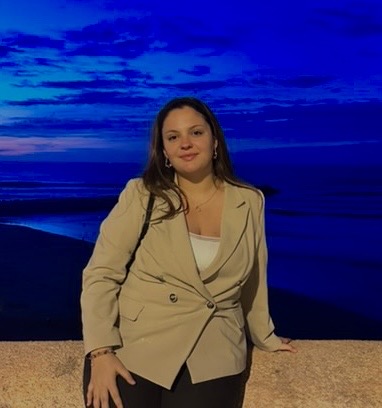 I’m Emma, a French political science student, and I am very happy to join NCWNZ as an intern until the end of June.
Back home, I’m the president of my university’s feminist association. We organise conferences and debates on all kinds of feminist issues, and we also try, patiently but persistently, to push our school to update its internal charters to make the institution more inclusive and safer for everyone. A lot of my time is spent somewhere between planning events, having big discussions about gender equality, and sending way too many emails.
Coming to New Zealand felt like a natural extension of that journey. I’m really looking forward to learning from such a historic and intergenerational organisation, and to discovering how feminism is lived and organised here.
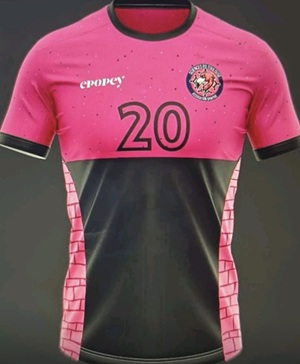 Outside of all that, I play rugby, so yes, I am very aware I have come to the right country. I’m already enjoying how seriously rugby is taken here.
And after the big storm that hit Wellington two days after I arrived, I feel like I’ve had my first proper Kiwi initiation! I can’t wait to discover the landscapes, meet more of you, and make the most of these next few months.
Ngā mihi,
Emma Guerin, NCWNZ Board Administrator
NCWNZ Past President Barbara Arnold MNZM
This is the fifth and final article of a series focusing on the NCWNZ Past Presidents Oral History Project with interviews by Carol Dawber in 2016. See the introductory article in The Circular at "NCWNZ Past Presidents oral history interviews from 2016" (August 2024).
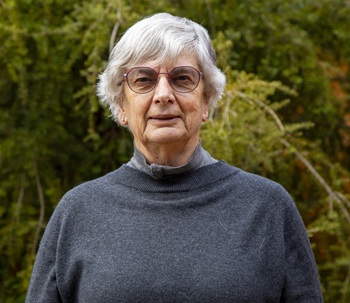 Barbara Joan Arnold née Furness MNZM was President of the National Council of Women of New Zealand from 2012 to 2014. Her contributions reflect a form of leadership that is rarely celebrated but deeply consequential. Over decades of involvement at branch, national, and international levels, Arnold combined scientific expertise, governance capability, and feminist commitment to help sustain the organisation through one of the most difficult periods in its modern history.
Born in Christchurch in 1950, Arnold grew up in a household where civic responsibility was assumed rather than debated. Her father’s involvement in the Labour movement and local government, and her mother’s working life in clerical and accounting roles, shaped an early understanding that women’s participation in public life was both normal and necessary. When Arnold expressed an interest in science, she recalls being encouraged without qualification—her father simply telling her that she could pursue engineering if she wished. That quiet affirmation shaped her expectations of opportunity and equality.
Girl Guides had a formative and enduring impact on her. From Brownies and Guides through to senior leadership roles, Arnold experienced Guiding as a practical training ground for women’s leadership. Over more than twenty years as a Guide leader and trainer, she gained national recognition for her service. Guiding, she reflected, gave women and girls “the opportunity to do non-stereotypical things,” fostering confidence, autonomy, and collective responsibility in ways that strongly aligned with feminist values.
Arnold pursued a Bachelor of Science with honours in zoology and ecology and built a career spanning teaching, environmental education, museum practice, and conservation governance. She worked in roles that bridged scientific knowledge and public engagement, consistently focused on making complex issues accessible. This ability to translate evidence into clear advocacy later became a defining strength in her NCWNZ work.
Her involvement with NCWNZ began in the mid-1980s through the Manawatū Branch, initially as an associate member. She recalls the branch as “the best discussion group in town,” marked by intellectual rigour and respectful debate across political and professional differences. Diversity, Arnold argued, was essential to good advocacy: “The bigger the variety, the more interesting the discussion, and the more information you’ve got to be able to come to some consensus.”
Arnold went on to play a major role in NCWNZ’s policy and submissions work, particularly through the Environment Standing Committee. Drawing on her scientific background, she contributed to submissions on water quality, chemical pollutants, biodiversity protection, marine reserves, and the Resource Management Act. She emphasised the organisation’s disciplined submission process: branch views collated, structured, checked for balance, and grounded in long-standing policy. As she observed, “One of the strengths of belonging to an organisation that’s been around for nearly 120 years is that you’re just another torch-bearer in a long chain.” This continuity, she believed, gave NCWNZ credibility and authority with ministers and officials. She was awarded Member of The New Zealand Order of Merit (MNZM) in 2005 for services to the environment.
Arnold served eleven years on the NCWNZ national Board, including two years as President. Her presidency coincided with one of the most challenging periods in NCWNZ’s history. Funding streams were increasingly uncertain, compliance requirements were tightening, and the organisation’s charitable status was abruptly challenged. The subsequent deregistration by the Charities Commission and the legal battle that followed dominated her term. Arnold described this period as one of “total focus on the court case,” consuming time, energy, and emotional reserves.
One of her most difficult responsibilities was overseeing the disestablishment of staff positions in order to keep the organisation solvent. Arnold later described this as the lowest point of her presidency, recalling the strain of having to “tell staff and follow through” while volunteers worked to keep the office functioning. At times, the survival of NCWNZ itself felt uncertain. Yet she remained determined that the organisation must not fold. Reflecting on her role, she later observed: “I’m not going to be the president that people remember, but I think that what I facilitated… meant the organisation could come out of that really low point and come back up again.”
Throughout this period, Arnold characterised her leadership as facilitative rather than directive. She described herself as “the backroom person,” focused on holding systems together, enabling others to contribute, and maintaining continuity when visibility mattered less than endurance. As president, she believed it was important “not to impose opinions on other people,” allowing consensus to develop through discussion rather than instruction.
Arnold also represented New Zealand internationally, including at meetings of the United Nations Commission on the Status of Women. These experiences reinforced her understanding of how fragile progress can be. “These things that are done with legislation can be taken away overnight,” she warned, reflecting on conversations with women from countries where rights had been rapidly eroded. For Arnold, this underscored the importance of civil society: “That’s the role of NCW… If we stop paying attention, we could lose it.”
Pay equity, parental leave, and women’s participation in non-traditional roles remained enduring concerns throughout her involvement. Arnold distinguished between formal equality and lived reality, noting that “just because it’s established in legislation doesn’t mean it happens.” She cautioned against complacency, particularly among younger generations, urging them to recognise the cumulative impact of caregiving, interrupted careers, and undervalued work. Progress, she argued, depended on persistence: “We’ll keep chipping, pass the banner on to the next generation and let them chip as well.”
After stepping down as president, Arnold found returning to branch life liberating. Freed from the constraints of national neutrality, she could again debate openly and contribute as an individual member. Yet her confidence in NCWNZ’s relevance never wavered. Sexism, she observed, had not disappeared but become more subtle, making collective advocacy as necessary as ever.
Looking back, Arnold measures achievement not in personal recognition but in institutional survival and continuity. NCWNZ endured a period when its future was genuinely at risk and continues to provide a national platform for women’s voices.
As this oral history series concludes, Barbara Arnold’s story reminds us that progress is sustained not only by visible leadership and landmark victories, but by the steady, principled work of those who ensure organisations endure long enough for change to take root.
By
Christie Underwood
~~~~~ ~~~~~ ~~~~~~ ~~~~~~
See also previous articles in this series:
- NCWNZ Past President Elizabeth Bang CNZM (25 October 2025).
- NCWNZ Past President Beryl Anderson ONZM (8 April 2025).
- NCWNZ Past President Barbara Glenie QSO (23 February 2025).
- NCWNZ Past President Janet Hesketh QSM, CNZM (24 September 2024).
2026 New Year Honours
The New Year honours for 2026 are a disappointment for women, with 55% of the awards going to men. This is especially noticeable with the higher awards where 83% of CNZM were awarded to men and 60% of ONZM. See the full list at the Prime Minister and Cabinet Office's website https://www.dpmc.govt.nz/publications/new-year-honours-list-2026. Here's the break-down for each honour by gender in the table below.
|
2026 New Year honours |
|||||||
|
Award |
Male |
Mx |
Female |
total |
% Male |
% Mx |
% Female |
|
ONZ + additional / honorary |
0 |
0 |
0 |
0 |
0% |
0% |
0% |
|
GNZM / DNZM / KNZM / hon |
4 |
0 |
3 |
7 |
57% |
0% |
43% |
|
CNZM + honorary member |
10 |
0 |
2 |
12 |
83% |
0% |
17% |
|
ONZM + honorary member |
21 |
0 |
14 |
35 |
60% |
0% |
40% |
|
MNZM + honorary member |
32 |
0 |
31 |
63 |
51% |
0% |
49% |
|
KSO |
1 |
0 |
1 |
2 |
50% |
0% |
50% |
|
KSM + honorary member |
29 |
0 |
28 | 57 | 51% | 0% | 49% |
|
NZAM |
0 |
0 |
0 |
0 |
0% |
0% |
0% |
|
DSD |
1 |
0 |
0 |
1 |
100% |
0% |
0% |
|
NZBD + NZBM |
0 | 0 | 0 | 0 | 0% | 0% | 0% |
|
Total |
98 |
0 |
79 |
177 |
55% |
0% |
45% |
|
sport-related |
30 |
||||||
|
arts-related |
26 |
||||||
|
ONZ to MNZM |
67 |
0 |
50 |
117 |
57% |
0% |
43% |
|
KSO & KSM |
30 |
0 |
29 |
59 |
51% |
0% |
49% |
Congratulations to all the winners, especially the following who were acknowledged for their contribution to women. Some to note are:
- CNZM
- Mr Gregor John BARCLAY, of Auckland. For services to sports governance. He has promoted gender equity in world cricket across increasing female participation and competitions and greater representation of women in governance positions.
- Professor Beverley-Anne LAWTON, ONZM, of Wellington, for services to women's health. Dr Lawton is founder and Director since 2008 of Te Tātai Hauora o Hine, the National Centre for Women’s Health Research Aotearoa (the Centre).
- ONZM
- Reverend Dr Patricia Ann ALLAN, of Christchurch, for services to survivors of abuse. Reverend Allan was one of the first women to be ordained in New Zealand.
- Ms Julie Anne HART, of Hastings, for services to women and victims of family violence. Ms Hart is recognised for her leadership of the Family Violence Intervention and Prevention Charitable Trust, creating a unified family violence service across Hawke’s Bay.
- Mrs Cecilia Charlotte Louise ROBINSON, of Auckland, for services to business and women. Mrs Robinson mentors the next generation of female leaders, actively supports women-led businesses and continually champions work-life balance and gender equity in the workplace and in healthcare.
- MNZM
- Mrs Judene Louise EDGAR, JP, of Nelson, for services to governance, local government and the community. Mrs Edgar is a former Nelson Branch member.
- Mrs Beverley Riverina FORRESTER, of Amberley, for services to the wool and fashion industries. Mrs Forrester is an active member of Rural Women New Zealand (RWNZ), holding many positions including Glenmark Branch President.
- Mrs Mokafetu (Matafetu) SMITH, of Auckland, for services to Pacific art. Mrs Smith was a member of PACIFICA, serving as President of the West Auckland branch in the mid-1990s.
- KSM
- Mrs Emily Myra CALDWELL, of Te Aroha, for services to the community and music. Mrs Caldwell has served on national and local committees for the Women’s Methodist Fellowship, having been a member for 70 years.
- Dr Tania Anne PINFOLD, of Wellington. For services to youth health. Dr Pinfold received the Rotorua Zonta Club’s Women’s Achievement Award – Community in 2007.
Information about nominating someone for an honour is available on the Department of the Prime Minister and Cabinet website. Nomination forms are accepted throughout the year, but the processing and consideration of nominations is likely to take at least six months prior to the announcement of an honours list at King's Birthday or New Year.
By
Beryl Anderson
Salvation Army’s State of the Nation report shows family violence has reached highest level since 2018
The eye-catching headline in RNZ News on 11 February 2026, “Family violence reaches highest levels since 2018” inspired an examination of the Salvation Army’s annual report, subtitled Foundations of Wellbeing, Poipoia te Kākanao.
While all five chapters of the report - Children and Youth, Work and Incomes, Housing, Crime and Punishment, Social Hazards – contain valuable information - the focus for the Safety, Health & Wellbeing Action Hub was on Crime and Punishment, and on family violence in particular.
Note, the report’s statistics and data are drawn largely from publicly available sources, including the Ministry of Justice’s New Zealand Crime and Victims Survey, which “measures population prevalence including unreported crime.”
Noteworthy points:
- Family violence remains a major concern for New Zealand, with police responding to a family-harm incident approximately once every three minutes.
- While violent crime has decreased, family violence has increased to its highest rate since 2018.
- The report revealed a significant increase in some offences particularly in relation to abuse of children:
- Child procurement or grooming increased 36.5 % in the past year and 550% over five years.
- Child abuse material offences rose 16% in the past year and 141.7% since 202.
- “Overall, the data indicates persistent high levels of assault-related offending alongside steep increases in child exploitation and online sexual offences, underscoring growing pressure on the justice system to strengthen its response to digital sexual harm.”
- Women experience family violence at three times the rate of men.
- Intimate Partner Violence (IPV): ex-partner violence accounts for nearly half (47%) of all IPV showing that danger for IPV victims does not stop when a relationship has ended.
- In 2025 police recorded 170,478 Family Harm Incidents (FHI), a 2.5% decrease from 2024 statistics.
- The report revealed a 3.9% increase in 2025 from 2024 in charges laid for family harm and a 9.7% increase in the issuing of Police Safety Orders (PSO) over the same period.
- “Many victims of family violence and sexual violence still face barriers to reporting, including fear of retaliation, shame, and concerns about family reputation.”
NCWNZ shares the concerns of other agencies working in the field of family violence prevention with regard to the final three points listed (in bold).
Barriers to reporting of family violence and sexual violence offences must surely include the knowledge of the anticipated likely, if not, inevitable re-traumatisation of the victim survivor through the court system.
The report asserts: “For the police, the steady rise in PSOs reflects a broader shift toward proactive policing and early intervention.” However, it seems obvious these statistics – reduction in FHI numbers and increase in PSOs - must reflect the implementation of the Police’s 2024 Risk Harm Attendance Framework, aimed at a reduction of police attendance at social harm callouts.
The stated aim of the Salvation Army’s report is to “promote debate and discussion about our progress towards greater wellbeing.”
The social policy analysts who prepared the report welcome feedback at: [email protected].
By
Bernice Williams, NCWNZ Safety, Health and Wellbeing Action Hub
Some of what's happening at local branches
The NCWNZ Wellington Branch recently hosted a free Women’s Self-Defence Workshop as part of our events raising awareness for the 16 Days of Activism Against Gender-Based Violence, and it was a fantastic success. A huge thank you to everyone who attended and to the Wellington Hapkido Academy for leading such an engaging and empowering session.
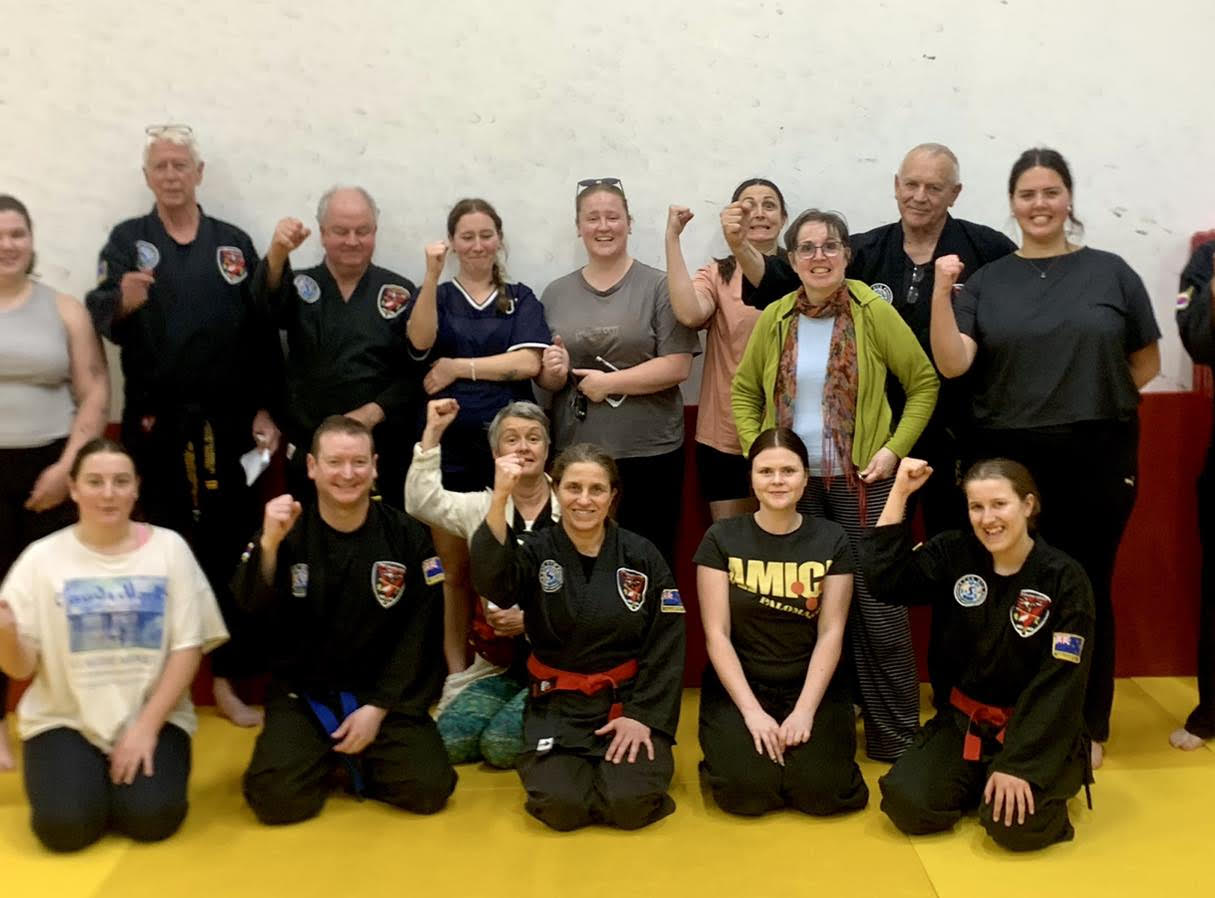
Participants gained valuable skills in awareness, confidence, and practical self-defence, and we received really positive feedback from those who took part.
We’re excited by the strong response and are hopeful to run similar events in the future!
By
Sarah Calley, NCWNZ Wellington Branch
NCWNZ Action Hubs
Climate change is here and the urgency to address it has never been greater. Extreme weather events, emergencies, and threats to lives and property are already impacting communities right here in Aotearoa and across the world. And research tells us that women and girls are more profoundly affected by the vulnerabilities that climate change brings. We need leaders and forward-thinkers now who will shape a better tomorrow. The NCWNZ Climate Change, Environment and Sustainability (CCES) Action Hub is dedicated to being a positive voice in this space. But with the urgency of climate disaster now on our doorstep, we need all hands on deck. We need to use NCWNZ's reputation and strength to raise awareness of the gender inequalities of climate change and influence government to address the dire outcomes women and girls will face.
If you are passionate about climate and the environment, bring your skills and knowledge to our CCES mahi and help us achieve a safer, more sustainable future for our wāhine. Get in touch at [email protected].
On 1 February 2026, the NCWNZ supported the International Action Hub's letter to the Prime Minister (copying also to the Minister of Foreign Affairs and the Minister for Women). This letter expressed our support for his government's decision to reject joining the U.S.-led Board of Peace and to celebrate New Zealand's continued support for a strengthened United Nations. Read the full letter here: https://www.ncwnz.org.nz/rejection_of_invitation_to_join_board_of_peace.
Resources to share in meetings and with your networks
Please let everyone know that security updates have come with the roll-out of the new NCWNZ website and your login account in Nationbuilder (the app that keeps your NCWNZ-related information safe and secure).
Starting March 10th, the Nationbuilder software will require routine password resets: Every six months, all users will be prompted to update their passwords. As Kerri DuPont, NCWNZ Comms Director puts it: "This is a security measure which protects us if there was a site breach. In that instance, someone won't have access to old, inactive logins to use for nefarious purposes."
No worries, everyone should get advance notice from NationBuilder (our site host) via their login email address before any action is taken.

Please share widely the link below put together by the Aotearoa Free From Stalking Team and supporters. This is the first edition of this resource (Dec 2025). They plan to release an updated edition once the Crimes (Stalking and Harassment) Amendment Act comes into effect (ETA May 2026).
https://awc.org.nz/stalking-response-guide/
Have you heard of the term "petro-masculinity"? Here's something from an ecofeminist political scientist in the U.S. for your networks to consider discussing:
Iyer, Monica, Law and Petro-Masculinity (January 30, 2026). Available for download at SSRN: https://ssrn.com/abstract=6156567.
Abstract:
The concept of "petro-masculinity," proposed by political scientist Cara Daggett, refers to a psychological and cultural association between fossil fuel extraction and use and the values of historically rooted gender hierarchies. It involves a fundamental association of extractivism and other forms of environmental destruction with power and masculinity, as contrasted with environmental protection which is understood as carrying connotations of femininity and weakness. To put it more bluntly, petromasculinity captures the notion that digging for coal, driving fuel-guzzling SUVs, or taking military action in order to control another country's oil is for strong men with guns, and worrying that the planet might become unlivable is for meek girls with flower crowns. This is an idea that is readily found in advertising, popular culture, and political rhetoric around the world. My contention is that it is also found in law. This article examines how petro-masculinity may be expressed and endorsed by those crafting law and policy in the United States and other countries. Drawing on feminist legal theory and ecofeminist discourse, I argue that such expressions of petro-masculinity impact and become embedded in law, through executive, legislative, and judicial decisionmaking. The influence of petro-masculine approaches has wide-ranging effects in limiting policy outcomes, through championing of climate denial, resistance to ending reliance on fossil fuels, commodification of nature, bolstering of authoritarian claims to power, deprioritization of gendered environmental harms, and gendered attacks on environmental defenders. Through this inquiry, I explore the possibility and necessity of addressing stereotypical social constructions of gender in order to meaningfully combat the inequalities and harms that they give rise to and the possible futures presented by a legal structure free of petro-masculinity.
Seen on Instagram from commonland4returns
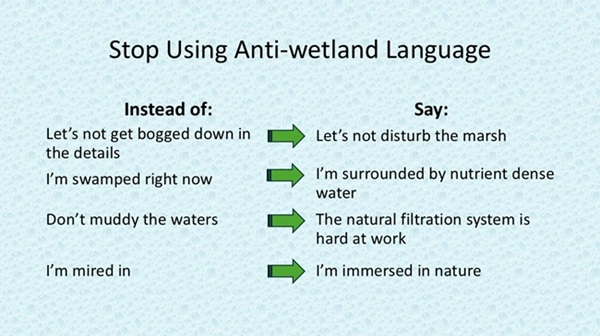
https://www.instagram.com/p/DUQFsKvDLv1/
We Are Not Your Dusky Maidens! is a series of short films exploring Pasifika women's responses to the historic exotic “dusky maiden” trope and the Western male gaze, as well as what floral adornment means to them, particularly while living away from their homeland. The women interviewed also speak back to the "dusky maiden" trope – shown in historic images from Te Papa’s collections – revealing how romanticised notions of the Pacific have shaped their own identities. Watch all five of the short films available on the Te Papa website at https://www.tepapa.govt.nz/discover-collections/read-watch-play/watch-we-are-not-your-dusky-maidens.
Did you see the Guardian article about Sarah Porter being pulled from the 108-mile Montane Winter Spine Challenger South in January? She was running as part of a fundraiser for Afghan women and girls and her InspiredMinds Foundation, which works to evacuate women from war zones and to provide educational opportunities. She received death threats, and the race officials decided the risk was too high -- her work in Afghanistan made her a target for assassins. A Mighty Girl urges us to learn more about the lives of girls and women in Afghanistan about life under Taliban oppression -- they have reading recommendations for both kids and adults in their blog post at https://www.amightygirl.com/blog?p=34254.
Readings to consider
On 24 February NCWNZ board members attended the launch of the People's Select Committee's final report on the government’s actions to overturn our formerly world-leading pay equity legislation. The Committee's ten former MPs held hearings for three months received over 1,500 submissions from people affected by the pay equity legislation enacted by the Coalition Government. The Committee found breaches of: the Regulatory Standards Act principles, the Legislation Design and Advisory Committee Guidelines, the New Zealand Bill of Rights, the Human Rights Act, ILO Convention 100, the International Covenants on Civil and Political, and Economic and Social Rights, CEDAW, the UN women’s Convention, and the Conventions on the Rights of People with Disabilities and the Elimination of All Forms of Racial Discrimination (ICERD). Eight key themes came out of the Committee’s analysis of what they learned, and the report offers many recommendations.
Read the full report on their website: https://www.payequity.org.nz/report
An article co-authored by Julie Choisne, Senior Research Fellow and Associate Director Equity & Diversity at the Bioengineering Institute, University of Auckland, analysed sex bias in the abstract submissions for the International Society of Biomechanics Conference of 2025.
Abstract:
Sex bias in cohorts occurs when one sex is overrepresented. This study evaluated sex bias in study cohorts among abstracts accepted for the International Society of Biomechanics (ISB) Congress in 2025. Analyses focused on subject inclusion and abstract characteristics by lead author affiliated country, research topic, and cohort type. Using NotebookLM Gemini 1.5 Pro and a predefined prompt, data were extracted and analysed from 1,394 accepted abstracts. Overall, 43% of relevant abstracts did not report sex distribution, 13% had very small samples sizes (<6 subjects), 18% had an unbalanced cohort (<30% representation of one sex), and only 26% had a balanced cohort. Among unbalanced abstracts, 64% showed an overrepresentation of male subjects, for which a scientific justification was provided in only 1% of cases; in female‑biased abstracts, justification was provided in 18% of cases. Variation in sex representation and reporting was observed across countries, topics, and cohort types, with applied domains such as Military and Sport biomechanics and Animal studies demonstrating lower levels of balance or transparency. Taken together, these findings indicate that sex distribution is frequently insufficiently reported or unevenly represented at the conference abstract stage, a critical point in research dissemination at which study design and recruitment may still be modified prior to journal publication.
Monnerat, Maxine and Blaker, Carina and Choisne, Julie and Clarke, Elizabeth Clare, Sex Bias in International Society of Biomechanics Conference Abstract Submissions: Patterns Across Cohorts, Countries, and Contexts. Download the paper at SSRN: https://ssrn.com/abstract=6233088.
In December 2025 the United Nations Committee on the Elimination of Racial Discrimination called on New Zealand to uphold Te Tiriti, making a specific recommendation to Government to “take measures to counter misinformation and divisive narratives regarding the Treaty and to promote public understanding of its role in advancing harmony and equality”. Te Kāhui Tika Tangata Human Rights Commission released a survey in February that revealed that almost three-quarters of New Zealanders think that honouring Te Tiriti is important for the future of Aotearoa New Zealand. According to the Commission, the survey was conducted by Horizon Research and found that "a sense of belonging, respect for human rights, and an understanding of our history are overwhelmingly viewed by New Zealanders as important to Aotearoa’s future. It also highlighted the importance of respectful discussion about Te Tiriti (viewed as important by 78%), positive relationships between Māori and the Crown (83%), and legal and constitutional protection of Te Tiriti (70%)." Download the full report from the Commission's website at https://tikatangata.org.nz/news/horizon-survey-almost-three-quarters-of-new-zealanders-think-that-honouring-te-tiriti-is-important-for-the-future-of-aotearoa-new-zealand.
Lead with youth is a new report released in January 2026 by the UNESCO Global Education Monitoring Report, in partnership with the UN Youth Office. Based on surveys issued to both governments as well as youth and student organizations, the report analyses how governments engage youth and student organizations in education legislation and policymaking. The report reveals that when there is participation by youth, it too often leaves their voices meaningless: young people can be "invited to the table but not truly heard." Read more and download the report at the UNESCO website: https://www.unesco.org/en/articles/new-unesco-report-reveals-gap-youth-participation-education-decision-making.
to keep an eye on... from Megan Hutching:
In January 2026, the United Nations General Assembly launched a four-year process to prepare for and negotiate a new global treaty to prevent and punish crimes against humanity by 2028. This will be different from the current ways the international community addresses war crimes and genocide. Read more in this article
Akila Radhakrishnan and Leila Nadya Sadat, "Serious Work Begins to Create a Treaty on Crimes Against Humanity," Pass Blue (22 January 2026): https://passblue.com/2026/01/22/serious-work-begins-to-create-a-treaty-on-crimes-against-humanity/.
Stories to celebrate
The European Parliament has passed a resolution urging members of the United Nations Commission on the Status of Women (CSW) to fully recognise transgender women as women. The resolution was passed on 11 February ahead of the upcoming 70th session of the UN CSW in March. The EU priorities to take to the session will include the assertion to “emphasize the importance of the full recognition of trans women as women, noting that their inclusion is essential for the effectiveness of any gender-equality and anti-violence policies; call for recognition of and equal access for trans women to protection and support services.” The non-binding European resolution passed by 340 votes to 141, with 68 members abstaining. Read more about this at MambaOnline.

Indigenous ocean leaders from across the Pacific and beyond gathered at Waitangi in February for Taiātea, a 10-day wānanga grounded in the moana as a living ancestor. Bringing together mātauranga Māori, Indigenous leadership and marine science, the hui focused on kaitiakitanga, tino rangatiratanga and collective action to protect Te Moana Nui a Kiwa.
Read more in Te Ao News: https://ow.ly/JaZg50Y45Nl
"Georgina Beyer in the Peace Garden" portrait, painted by artist Sarah Jane Moon, has been acquired for New Zealand’s national collection at the Alexander Turnbull Library. Beyer (1957-2023) was the world’s first openly transgender mayor in 1995 and later became the first openly trans Member of Parliament in 1999.
Read more in Waatea News: https://waateanews.com/2026/02/02/national-portrait-of-trailblazer-georgina-beyer-enters-national-collection/.
Former Chilean President Michelle Bachelet has submitted her papers to be a candidate for the next secretary-general of the United Nations. Bachelet served twice as president of Chile (2006-2010 and 2014-2018), the country’s first female head of state. She held senior roles at the UN, including as the executive director of UN Women and then the high commissioner for human rights (2018-2022). Read more at Pass Blue: https://passblue.com/2026/02/02/michelle-bachelet-of-chile-is-running-for-the-uns-top-post-with-regional-backing.
The Women Deliver 2026 Conference (WD2026) will take place from 27–30 April 2026. The conference will be regionally hosted for the first time — by the Oceanic Pacific — in Narrm (Melbourne), Australia, on the unceded lands of the Wurundjeri Woi Wurrung Peoples of the Kulin Nation. Read more about this conference here.
Celebrate the birth of the Commission on the Status of Women! Did you know that during the early meetings of the United Nations General Assembly in London in February 1946 that Eleanor Roosevelt, U.S. delegate, demanded a UN group devoted to (and led by) women? She called for "the women of the world" to "take a more active part in national and international affairs... to come forward and share in the work of peace and reconstruction as they did in war and resistance." The Subcommission on the Status of Women was established within the Commission of Human Rights with Bodil Begtrup of Denmark as the first chairperson. Then on 21 June 1946, the Subcommission formally became the Commission on the Status of Women. Read the short history (written in 2019) on the UN website here: https://www.unwomen.org/sites/default/files/Headquarters/Attachments/Sections/Library/Publications/2019/A-short-history-of-the-CSW-en.pdf.
Dates to note for March 2026
8 March - International Women's Day
10 March - International Day of Women Judges
9 to 19 March - United Nations Commission on the Status of Women 70th session at UN headquarters in New York U.S.A.
30 March - International Day of Zero Waste
Quotation to ponder
"Why should my daughter, or anyone, feel hopeful in a world where there is climate change denial? Where there is so much hate, vilification and extremism in the virtual world in which we now spend so much of our lives? And when the politicians we elect to solve these problems increasingly propagate them? Or the solutions that are put in place are simply rolled back in new electoral cycles? ... when I was prime minister, I saw moments of true darkness, too. But there's an inverse feature to seeing the world at its most brutal, because those are also the moments that show people at their most humane. Those are the moments when I saw that it was possible for people to galvanise behind their collective humanity. Sometimes, those moments are small. Other times, they create a ripple that sweeps across a country."
-- Jacinda Ardern, A Different Kind of Power
(Penguin, 2025), p. 337.
Whakataukī to share
Ehara taku toa i te toa takitahi, engari kē he toa takitini.
My success should not be bestowed onto me alone, it was not individual success but the success of a collective.
This whakataukī acknowledges team effort, that one’s success is due to the support and contribution of many. Just as it takes a village to raise a child, it takes community -- or a team -- to enable an individual’s success.
-=-=--=-=-
The Circular is the official newsletter of The National Council of Women of New Zealand. Archived copies are available at the National Library of New Zealand (ISSN 2815-8644).
Do you have some news to share? Please send an email to the newsletter managing editor, Randolph Hollingsworth, at [email protected].