
 |
|
September-October 2025, Issue 654 | Action Hubs | News | GenderEqual NZ | |
Table of Contents
 |
| Suzanne Manning NCWNZ President |
President's kōrero
Kia ora koutou,
Welcome to the last Circular for the year! I’d like to take the opportunity to thank Randolph for her continued dedication to bringing you the NCWNZ news and views every two months. It is always a pleasure for me to read about the happenings in our organisation, and I trust you find it equally enjoyable.
The Circular is one way we tell our stories to the world. The AGM and the NCWNZ Annual Report is another - thank you to all those who attended and who voted at the AGM. The amended Constitution that you passed will be uploaded with our Incorporated Society re-registration in the new year, so your participation in the AGM was essential.
The Gender Attitudes Survey launch was another public way of telling the world about who we are and what we care about, and we received a lot of media attention with that event. (See the NCWNZ press release here - and our YouTube video here.) We also tell our stories through the webinars that the Action Hubs run to raise awareness, the ongoing stream of considered submissions to Parliament and government agencies, and the speech and essay competitions, suffrage sites maintenance, local election candidate meetings, and a myriad of other branch activities.
It has been a hectic year all around the motu - islands, what with defending Te Tiriti o Waitangi, protesting changes to the Equal Pay Amendment Act, supporting the Cook Island NCW at their conference as they prepare to report to CEDAW, and the usual IWD and Suffrage Day events. We even had Carin, one of our Board members, connecting with our Swedish counterparts! I, for one, am looking forward to slowing down for a bit, taking some rest and recovery time.
If I told you the number of days until Christmas, would that excite you or scare you?? But whatever your summer holiday traditions are, I sincerely hope that they involve leisure time spent in the company of those you love, and doing the things that sustain your wairua – your spirit.
Look after yourselves and each other, whānau.
Suzanne Manning
President
Women's Art Fund - Amplifying Women Artists and Designers
NCWNZ representatives were warmly invited by City Gallery Wellington Te Whare Toi to attend the launch of the inaugural Women’s Art Fund at Oriental Bay in Wellington. We are grateful to Liz and Robert of Foggy Valley Aotearoa Trust for hosting this special event and welcoming us into a space filled with enthusiasm for creativity, equity, and cultural leadership.
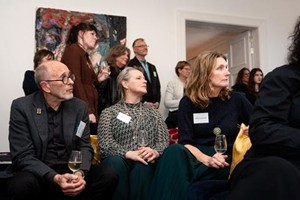 During the evening, we had the opportunity to hear from the inspiring women behind the Women’s Art Fund and their project and vision. The fund aims to provide vital financial support for the creation of new works by women artists and designers, and to address gender inequities in the arts, including the underrepresentation of women in solo exhibitions, gallery representation, and public commissions.
Speakers shared alarming statistics that highlighted the urgency of this initiative: although 70% of fine arts students in Aotearoa are women, only 37% of artists represented by dealers and 40% of solo exhibitions in public galleries feature women. A striking example illustrated this imbalance: in a fine arts class of 22 women and eight men, only four of the “successful” artists are likely to be female, giving men a 75% chance of success compared to just 18% for women. Men also have 30% more opportunities to exhibit in public galleries.
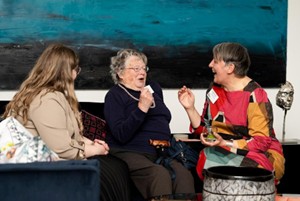 Guests were encouraged to take part in this project by contributing donations to help achieve the fund’s goal of supporting women’s voices and creativity in the arts. On the night, $23,500 was raised towards the target of $250,000 marking an inspiring beginning for this important initiative.
The launch of the Women’s Art Fund represents an important step toward expanding opportunities for women artists to create and exhibit their work. You can read more about the initiative at this website: https://citygallery.org.nz/womens-art-fund/.
By
Carin Sundstedt, NCWNZ Board Member
and
Manon Valls, NCWNZ Board Administrator
NCWNZ Past President Elizabeth Bang CNZM: From the Wards to Women’s Leadership
This is the fourth of a series of articles focusing on the NCWNZ Past Presidents Oral History Project with interviews by Carol Dawber in 2016. See the introductory article in The Circular at "NCWNZ Past Presidents oral history interviews from 2016" (August 2024).
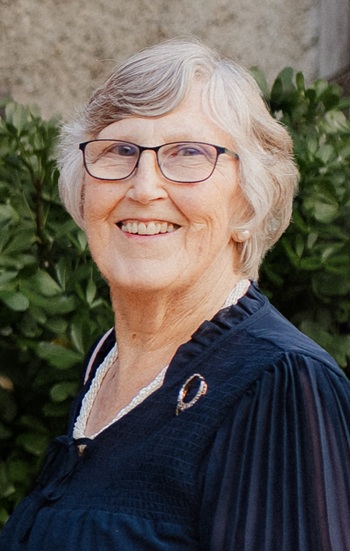 Elizabeth Margaret Bang (née Ewart) was born in Palmerston North in 1942, growing up in a family where thrift, hard work and service were values carried through generations. Her father, Richard, was a Marlborough stock and station agent; her mother, Cora, had hoped to be a teacher but instead became an office typist. Those early experiences of economic constraint and community-mindedness shaped Elizabeth’s lifelong sense that care and fairness must guide public service.
After schooling in Waipukurau, Feilding and Palmerston North, she trained as a registered nurse in general and obstetrics and became a ward sister by her early twenties. She later moved south to Dunedin, combining nursing with study towards a Certificate in Social Work at the University of Otago and later a Diploma in Health Administration at Massey University. Her work in orthopaedics opened her eyes to the emotional toll of illness on families. “You could fix a bone,” she reflected, “but you couldn’t always fix what happened to people’s lives when someone was in hospital.” That understanding of both clinical and human dimensions would define her approach to leadership.
In 1966 she married Bryan Bang, then a geography student whose career would later span urban planning and law alongside his PhD. The couple made an early pact that one parent would always be home with their daughters, Catherine and Helen. Elizabeth worked evening nursing shifts while Bryan studied and read bedtime stories. “It was unusual then,” she said, “but it worked for us.” Their partnership, grounded in shared purpose, reflected the social changes taking place for women in 1970s New Zealand.
Over twenty-four years in Dunedin, Elizabeth rose through the hospital system to become charge nurse of the fracture clinic; followed by Orthopaedic & Trauma Supervisor then later a member of the surgical management team during the major health restructures of the late 1980s. Her understanding of both nursing and administration made her indispensable. When the opportunity came to help establish a pilot breast-screening programme, she joined the nucleus group that would later guide national policy.
In 1994 she was awarded a Winston Churchill Fellowship to study breast-screening systems in Sweden, the United Kingdom, Edinburgh and Australia. “They just handed me a white coat and said, ‘You’re a colleague from New Zealand.’ It was an incredible privilege.” The experience deepened her commitment to evidence-based practice and communication—principles she would later carry into her work with the National Council of Women.
After moving to Hamilton, Elizabeth joined the Public Health Directorate of the Ministry of Health and then onwards to join the team to set up Breast Screen Aotearoa. Elizabeth then later led Hospice Waikato as Chief Executive from 2002 to 2012. Under her leadership, hospice services expanded dramatically, including the creation of the children’s unit Rainbow Place and an $8 million fundraising campaign for a new facility. She insisted on ongoing supervision for hospice nurses, believing “you can’t work with death every day without reflection and support.”
Elizabeth’s involvement with the National Council of Women began through the New Zealand Nurses’ Organisation. She became convenor of the Health Standing Committee, leading influential surveys on maternity services and the care of carers. “We learned to build a nucleus group of experts,” she said. “That gave our surveys real credibility.” She was elected to the NCWNZ Board in 2002, served as Vice President from 2004 to 2008 under Christine Low, and became President in 2008.
Her presidency coincided with one of the Council’s greatest challenges—the loss of charitable registration when the Charities Commission ruled NCWNZ a political lobby group. Funding stopped overnight and staff were laid off. “We felt tainted,” she recalled. “It was as if we’d done something wrong, when all we had done was speak up for women.” Determined to protect the organisation’s integrity, she worked with lawyer Sue Barker to rebuild the case for charitable status. She personally took leave from work to compile evidence in Wellington and guided the High Court appeal that eventually succeeded. “I had to keep believing,” she said. “We were fighting for NCW’s survival, and for the principle that advocacy is part of charity.”
During those same years, Elizabeth led the “Cotton Off Our Kids” campaign, which challenged sexually explicit slogans on children’s clothing. Within 48 hours of NCW’s statement, international media pressure forced the retailer to withdraw the products. “It went international overnight—calls from Canada, the UK, even New York asking how we did it,” she remembered. “That’s the power of a large group, a well-presented argument, and a good media relationship.”
Elizabeth also oversaw a complete rewrite of the NCWNZ Constitution, modernising its structure and language to reflect a changing membership. She encouraged virtual branch models for rural areas and closer partnerships with the Ministry for Women, Māori Women’s Welfare League, YWCA and Rural Women New Zealand. She believed that NCWNZ should always remain a place for learning and growth: “It gives women the ability to learn how to run meetings, how to present to Parliament. Those are lifelong skills.”
Her presidency reaffirmed the Council’s credibility, not only in the eyes of government but also within its own membership. She stayed on after her term to assist with constitutional reform until its unanimous adoption in 2014. “You can have the vision,” she said, “but unless you persuade the group to travel that path with you, it won’t happen. It has to be a team.”
Elizabeth’s contribution was recognised nationally with numerous honours: Member of the New Zealand Order of Merit in 2003, Companion of the New Zealand Order of Merit in 2018, and the Paul Harris Rotary Fellowship in 2011 for community leadership and fundraising.
Now a Life Member of NCWNZ, Elizabeth continues to serve on health, ethics and diocesan boards in the Waikato. Her reflections remind us that equality is an ongoing journey: “We were the first country to win the vote, and people still look up to us for that. But equality isn’t finished—it moves with every generation.” From hospital ward to hospice boardroom, from nursing supervisor to national president, Elizabeth Bang’s career is nothing short of inspiring. Elizabeth’s achievements reflect the enduring mission of the National Council of Women; to advance the wellbeing of women, families and communities through service, collaboration and care.
By
Christie Underwood
~~~~~ ~~~~~ ~~~~~~ ~~~~~~
See also previous articles in this series:
- NCWNZ Past President Beryl Anderson ONZM (8 April 2025).
- NCWNZ Past President Barbara Glenie QSO (23 February 2025).
- NCWNZ Past President Janet Hesketh QSM, CNZM (24 September 2024).
In Memoriam: Myra Harpham
 The NCWNZ Hutt Valley Branch mourns the passing of Myra Harpham (8 May 1931 – 15 August 2025).
Myra joined the Hutt Valley Branch in the mid 1970s as the representative for the then Federation of University Women Hutt Valley, later becoming an Associate. Myra was awarded a Distinguished Service Award 2012.
Myra represented NCWNZ as a consumer representative on Standards NZ. She was a member of NCWNZ’s Economics Standing Committee and the Consumer Affairs Standing Committee contributing to submissions on electricity, energy, and broadcasting. She also served on the NCWNZ Status of Women Committee.
Myra regularly researched and informed the Branch on Action items with her prime areas of interest being energy and justice. Myra was a member of the Commission for the Future, assisting in the development of their Futures Kit published in 1982. In 2003 Myra was a key member of the team that wrote the Hutt Valley Branch report on Young People and Alcohol. Myra also contributed to Federation of Graduate Women reports such as "Ending Intergenerational Dysfunction in NZ Families: The Importance of Early Intervention," in 2009.
By
Beryl Anderson
Celebrating Suffrage Day in middle North Island: Whanganui hosted Manuwatu branch
On the 18th of September, four NCW Manawatu members joined with their counterparts at Mint café in central Whanganui, for the beginnings of a tour around local suffrage sites.
The next stop was the museum, where there is a permanent display of three early suffragists: Margaret Bullock, Jessie Williamson, and Ellen Balance. These three were key to advocacy efforts in the region, and they collected signatures for the 1893 petition. Along from this display, members enjoyed the sight of costumes through the past, finishing with Costume of the Month. The museum visit concluded with a viewing of a photographic exhibition of churches in the district.
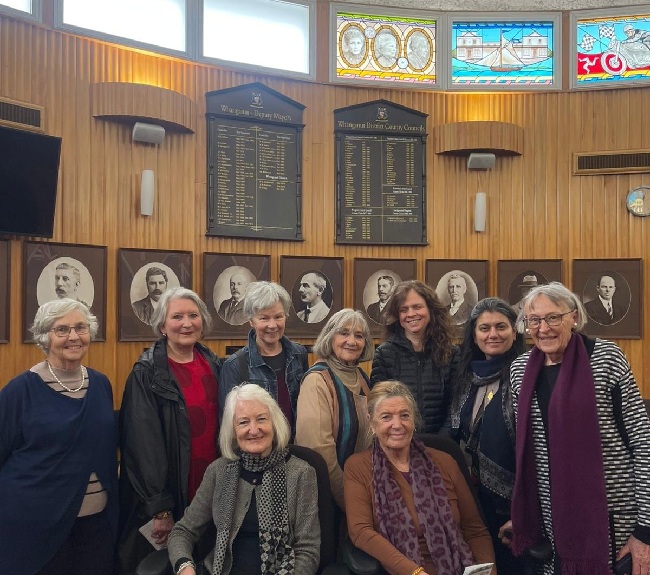
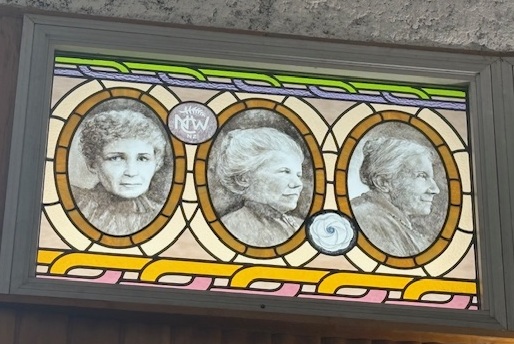 From the museum, the group made their way to the Whanganui District Court, where a stained-glass window to the three above Whanganui suffragists, created by Julie Greig and Greg Hall, has recently been placed. This window was sponsored by NCWNZ Whanganui branch. (See more about this commemorative window in a previous article in The Circular.) Overall, the windows, placed high on the side walls, create a light and colour-filled summary of Wanganui history.
Following lunch together, the Palmerston North group visited the must-see Sargeant Gallery, which opened this year after extensive refurbishment. The new building unites old and new with an entrance, staircase, overbridge and waka between, and allows modern facilities to blend harmoniously with the limestone grandeur and dignity of the original.
NCW Manawatu particularly enjoyed meeting up with the five NCW women from Whanganui, where we could share our activities and plans, and deepen links for the future.
Below: Whanganui and Palmerston North NCW members pose for a photo below the suffrage window at the Whanganui District Council. (Photo courtesy of Fatima Junaid).
By
Geraldine Anne McCarthy, NCWNZ Manawatu Branch
United Nations funding for women's initiatives at risk
United Nations Secretary-General António Guterresis indicated recently that the UN could end 2025 with a deficit of more than US$450 million, even after reducing the spending by nearly US$600 million. The United Nations is facing a liquidity issue as Member States are delaying or not paying their assessed contributions on time, particularly since 2024. This funding shortage impacts the UN's ability to operate effectively, as its budget relies on member contributions to cover expenses. These funding cuts threaten women's rights around the world -- not just by threatening access to women's humanitarian organisations but also choking off women's voices in humanitarian planning and policy decisions.
Since 1981 the Convention on the Elimination of All Forms of Discrimination against Women (CEDAW) has provided reporting procedures that clarify the activities of signatory nations relating to women's rights. New Zealand became a signatory in accepting CEDAW in 1985, committing to the principles laid out. In 2000 New Zealand also ratified the CEDAW Optional Protocols which allow individuals and groups to complain to the Committee about violations of the CEDAW and allows the Committee to investigate those abuses of women's rights. The Manatū Wāhine NZ Ministry for Women is responsible for administering the nation's official CEDAW reports and its Optional Protocol.
The liquidity situation has caused some CEDAW sessions to be cancelled, postponed, or changed to being online. For example, the Cook Islands were listed to report to the 93rd session from 22 Jun 2026 to 10 Jul 2026, but their slot is uncertain and is yet “to be confirmed”. The 94th session 27 Oct 2025 to 31 Oct 2025 where the Pre-Sessional Working Group (PSWG) was to develop the List of Issues Prior to Reporting was replaced by online informal meetings. Vaine Wichman, the President of the Cook Islands National Council of Women, presented their UN shadow report online (see their Facebook video here).
The CEDAW committee for the National Council of Women of New Zealand has been leading efforts to collaborate with other Non-Governmental Organisations (NGOs) to produce an alternate report. You can find the latest contribution by NCWNZ here: https://www.ncwnz.org.nz/cedaw.
According to a recent article by Raphaël Viana David of the International Service of Human Rights, as of 3 October 2025, only 139 Member States (72%) have paid their dues in full. Members that have NOT paid their dues in full include:
- 9 members of the UN Human Rights Council: Benin, Bolivia, Burundi, Chile, China, Cuba, Ghana, Malawi, Mexico.
- 4 members of the UN Security Council: China (permanent), Russia (permanent), the US (permanent), Pakistan.
New Zealand has paid mostly on time within a 30-day period (at least 4 out of 7 years). While defunding of the Human Rights Commission initiatives continue to crop up in the UN, none of them have been successful so far. New Zealand's continued leadership in the many different international collaborations to provide a voice for all women is crucial.
For more reading on this, see:
-
- "UN liquidity crisis: analysis of contributions paid by UN Member States by date of payment (2019-2025)," News (21 October 2025), International Service of Human Rights, https://ishr.ch/latest-updates/un-liquidity-crisis-analysis-of-contributions-paid-by-un-member-states-by-date-of-payment-2019-2025/
- "Humanitarian funding cuts threaten women’s rights: What’s at stake and how to help," Stories (15 May 2025), UN Women Asia and the Pacific, https://asiapacific.unwomen.org/en/stories/explainer/2025/05/humanitarian-funding-cuts-threaten-womens-rights
By
Beryl Anderson
CEDAW Convenor, Te Kaunihera Wāhine o Aotearoa - National Council of Women New Zealand
[email protected]
New Zealand women and the Polyglot Petition
This article is the second in a series of articles for The Circular by the members of the NCWNZ International Action Hub. The series highlights the many different international treaties to which New Zealand is a signatory and how this impacts women and girls.
One of the founding member organisations of the National Council of Women of New Zealand, the Women's Christian Temperance Union of New Zealand (WCTU NZ) led a campaign to contribute to an international initiative, "The Polyglot Petition for Home Protection." The 4,000+ signatories of women from New Zealand would have seen themselves as part of a global effort to convince heads of state to work together to address the scourge of violence resulting from the state support for and individual use of alcohol and drugs.
This world-wide campaign of the Polyglot Petition was the first global proclamation against the international trade in alcohol and drugs. The petition was initiated by the World Woman's Christian Temperance Union in 1885, and its American president Frances Willard penned the petition to be submitted to national leaders. The destructive effects of the highly addictive version of opium used in the drug trade had funded and maintained several European empires through the nineteenth century. The Polyglot Petition was the first international campaign to raise awareness about the controls needed for opium and its derivatives as well as for the liquor trade.
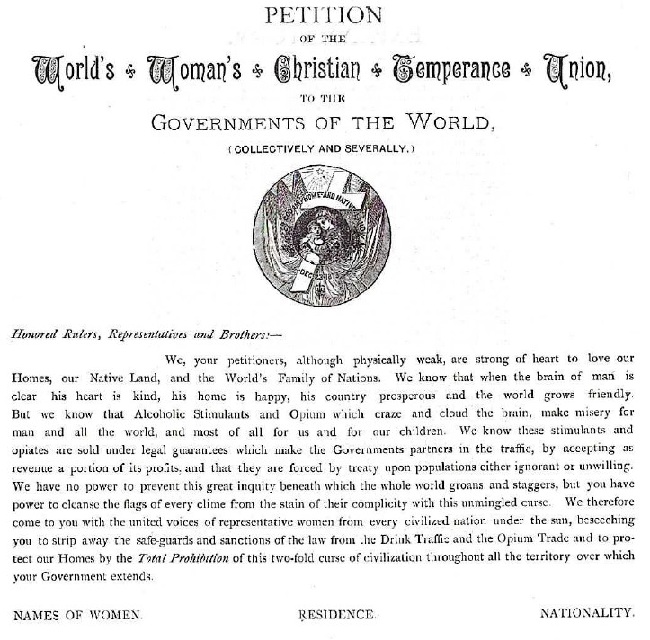
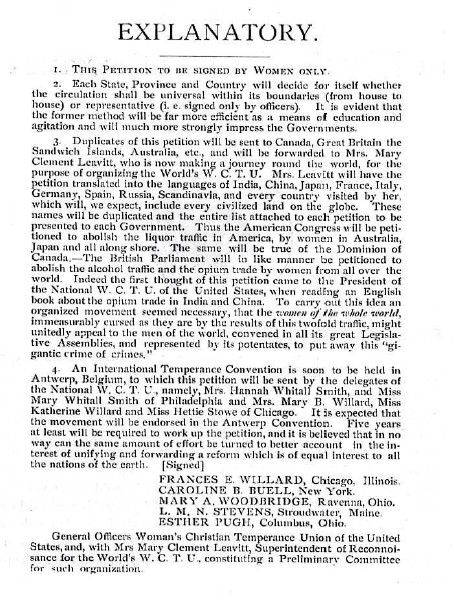
The WCTU NZ was an anomaly in the political and social scene of New Zealand in its founding. Typically, the temperance societies expected women to stay in the background, preparing and serving tea. Women's leadership in these settings was usually expressed in leading hymn singing while men spoke at length from the podium and led the prayers. As a women-led organisation, the WCTU NZ offered a public platform not only for religious-based temperance homilies or fundraising efforts for social charities, but also for political speech designed to change local, regional and national laws. Specifically, for direct political action within the public arena. The preparation and launch of the Polyglot Petition serves as a paradigmatic case of this turn of women as political actors in the international public sphere.
In February 1887 at the second national convention of WCTU NZ, president Anne Ward née Titboald (1825–1896) laid out the plans for getting the Polyglot Petition campaign going. They had five years to get signatures back to the U.S. where they would be combined with the other nations' results. Emma Eliza Packe née de Winton (1840–1914), the founding president of the Christchurch WCTU, was elected national president at that conference. Under Ward's then Packe's leadership, the WCTU NZ local chapters joined together to present multiple petitions to the New Zealand Legislative Council: to change the hiring practices of local pubs to protect young girls and women, to expand women's suffrage from municipal voting to include them in the national elections, and more.
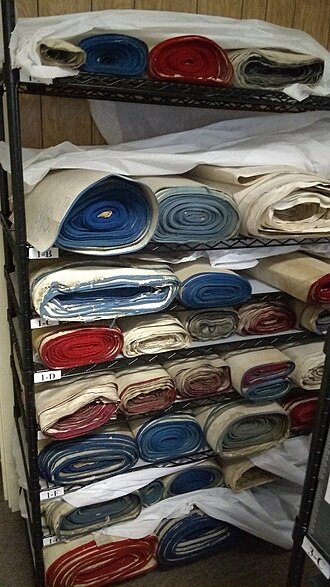
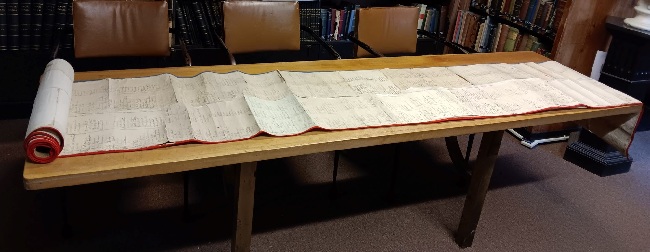
In her President's Address at WCTU NZ's Fifth Annual Convention in Dunedin in February 1890, Packe announced she and Mrs. George Clark (founding superintendent of the Franchise Department) had sent 4004 names to the U.S. to add to the Polyglot Petition. The WCTU ultimately gathered signatures of nearly eight million people in more than fifty countries. The first two conventions of the World's WCTU -- Boston in 1891 and Chicago in 1893 -- the petitions as wall-coverings to show the breadth and scope of the global effort. The New Zealand signatures were also part of the rolls exhibited in 1895 in Cleveland for the U.S. President Grover Cleveland before they were shipped to England to be presented to Queen Victoria in June 1895. and then on a world-wide tour.
Mounted on white muslin and bound by red and blue ribbons, the New Zealand signatures are archived in the Woman's Christian Temperance Union Administration Building in Evanston, Illinois, United States of America.
By
Randolph Hollingsworth PhD, International Action Hub
***
See the other articles in this series here:
"Convention Against Torture & Other Cruel, Inhuman or Degrading Treatment or Punishment," by Megan Hutching PhD (August 29, 2025). https://www.ncwnz.org.nz/convention_against_torture
Some of what's happening at local branches
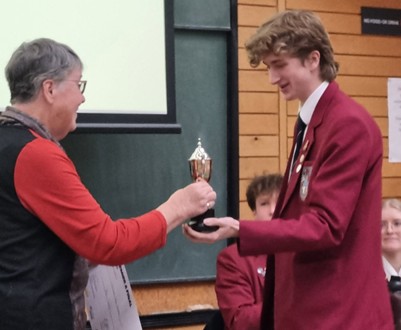
The Wellington Speaking Union organises the Senior Premier A Grade, the top debating grade within the Intercollegiate debating competition. The winning school receives the John F Henning Cup, donated in 1961 by the then United States Ambassador to New Zealand. The best speaker in the Grand Final is presented with the Suffrage Cup, donated by the Hutt Valley branch of the National Council of Women of New Zealand.
This year the students debated the following moot: This House believes that social and political movement should utilise religious rhetoric in forwarding their cause (eg using religious texts, seeking support from religious leaders, etc.). This year’s finalists were Wellington College (affirming) and Scots College (negating).
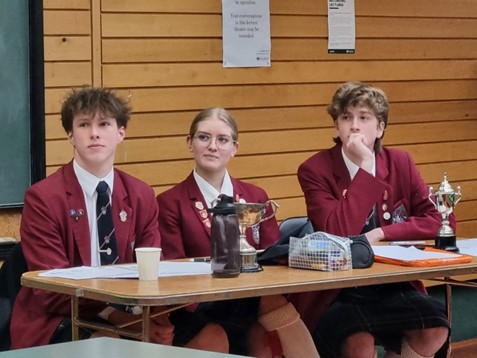 |
| Scots College debate team |
After a vigorous debate, the judges’ decision awarded the Henning Cup to Scots College and the Suffrage Cup to their third speaker Sebastian Heine-Sheldrake.
 |
|
NCWNZ's Beryl Anderson presenting the Suffrage Cup to Sebastian Heine-Sheldrake. |
By
Beryl Anderson, NCWNZ Hutt Valley Branch
In the last few months, NCW Manawatu has continued the pattern of bimonthly speakers.
 In May, Fatima Junaid, a branch member, spoke about "Mechanisms to support migrant women entrepreneurs' wellbeing.’" Fatima outlined the need for confidence and resilience to combat aspects from misnaming to company access to jobs which fulfil diversity requirements with little desire to recognise culture or value systems. Women entrepreneurs survive through key support groups, creating their own networks and creating emotional boundaries against naysayers. Fatima concluded with the reminder that acceptance of ethnic and cultural diversity, creates the synergy for a more harmonious society.
In July, Martin Bassett delivered a riveting overview of the history of Israel, its beginnings with the emergence of Zionism, to the British and French involvement in the Middle East, to world wars and the present crisis. He presented the reality of Israel as a consequence of the continued persecution of Jews in different countries, power struggles between world blocs and greed for resources.
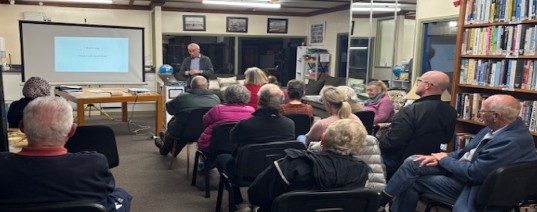
In September, the branch joined with the Whanganui branch to celebrate Suffrage Day. See more on this at https://www.ncwnz.org.nz/celebrating_suffrage_middle_north_island. We look forward to hosting our NCW neighbours at future Suffrage Day events.
By
Geraldine Anne McCarthy, NCWNZ Manawatu Branch
Manukau Branch of NCW hosted a "Meet the Candidates" afternoon on Saturday 13th of September for women standing in the local government election representing the Manukau region.
We had 20 women candidates attend to speak with us about their reasons for wanting to be elected. It was a successful afternoon which saw all women interacting and supporting each other regardless of their political stripes.
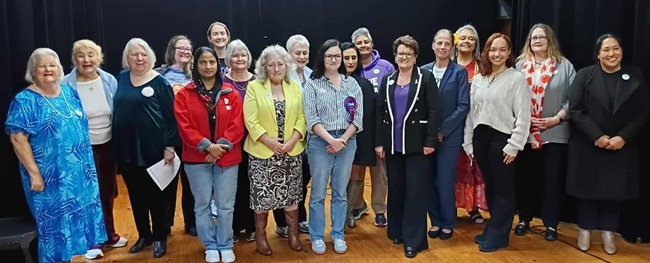
We joined together in an afternoon tea where there was an opportunity of everyone to have an informal chat together. We presented each candidate with a fun "Women at the Table" survival kit which went down a treat.
Here's the contents for the "Women at the Table" survival kit:
Her Seat at the Table Pack
Remember: you’re not just running in an election—you’re running for every woman who ever thought she couldn’t.
Star – remember you are the star of your show, shine brightly
Peg – sometimes might feel like a square peg in a round hole, keep going!
Plasters – For those “battle scars”
"Pivot" Coin – To flip when a new direction is required.
Small Mirror – For a quick moment of self-reflection
Marble – for when you feel like you are losing yours
Jigsaw piece – you are an important piece of our future
Salt – take things with a pinch of salt
Toothpick – pick out the good bits of fellow politicians
Smartie - to remind you that you are smart and clever
Cross – when all else fails, pray!
By
Angela Dalton, NCWNZ Manukau Branch
Interacting with younger persons evokes feelings of amazement at their enterprise, wonder at their ability to absorb new ideas and pride in their achievements while working in challenging situations. NCWNZ Southland Branch has four activities which allow members to revel in these feelings while celebrating the value these young people bring to members’ lives.
Southland Social Science Fair
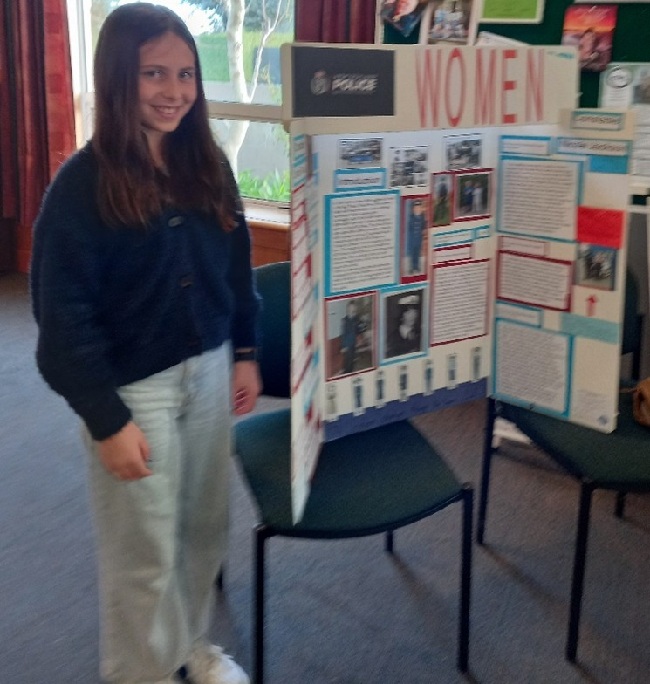
In the first instance the branch sponsors two prizes in the Southland Social Science Fair. It is open to students from year 5 to year 13, to create exhibits about a wide range of themes. From amongst this year’s 300+ presentations NCW judges had to find ones that featured women’s issues.
This year’s winner was Yr 9 Tatum Wessel whose topic was Women in NZ Police. The presentation and research involved was outstanding. Tatum was the guest speaker at the Branch’s July meeting.
Teenage Parents
Way back in 2009 the Branch was involved, with others, in lobbying Government to develop a school for teenage parents, by writing letters and meeting with relevant Ministers when they visited Invercargill. Success happened in 2011 with the opening of MYPLC (Murikihu Young Parents Learning Centre aka My Place). The Branch retained its interest by attending graduation days and donating gifts of cosmetics on Mother’s Day to each of the parents. The Branch meetings were held there up until the onset of Covid. This year our donation will go up a notch, with the sponsorship of a Kaitiaki/leadership prize of $500 to a student chosen by the staff.
Suffrage Breakfast
Each of the local secondary schools is invited to send two students as guests to our traditional Suffrage Day breakfast where they hear a local inspiring woman speaker. The students always enjoy this event. Last year all the attendees were also invited to test their knowledge through the quiz about NZ suffrage history, that was available from NCWNZ website. Feedback revealed that the MYPLC girls insisted that all their students and the staff must take that quiz and they did! This year they were given a quiz entitled "It is all in the numbers." The quiz papers are put on the breakfast tables and prove to be good conversation starters.
Future NCWNZ Members
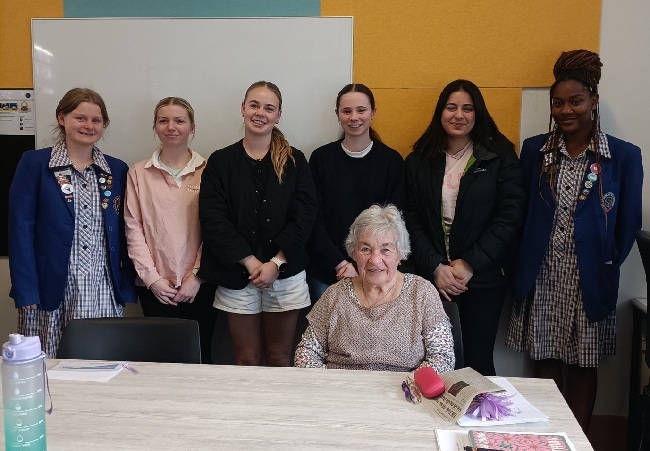
After some negotiating with an enthusiastic teacher, the Branch is developing a relationship with one of those secondary schools. It involves two branch members visiting the school for one lunchtime per term to raise issues with them. It is a small focus group of around six senior girls of diverse experiences, and a teacher, who all willingly participate in the discussions.
The first term we discussed the Crimes, Harassment and Stalking Amendment Bill. The second was based on one of the survey papers from Gender Equality NZ. The third began with NCWNZ Resolution 1.6.3.2 (from 1898): "That it is absolutely essential for a Christian state to keep its orphaned and neglected children beyond the age of fourteen, and to prepare such children for the work that seems most suited for each." While this is a ‘retired’ resolution, the discussion centred on the social climate at the time then led to the current situations.
For term four, the moot was Australia has approved social media ban on under-16s. Should NZ follow suit? A lively discussion ensued. In summary, the girls understood both sides of the question but overall tended to agree that NZ should follow suit, with the caveat that education was still crucial to such a law being successful.
At the end of each session there is a simple evaluation form to fill in. The comments have all been positive about the activity and the topics so far, as demonstrated by the evaluation forms from term four:
A. I really enjoyed today’s topic because it was a topic I understood and could discuss B. Today was a massive thought provoking topic which I quite enjoyed
C. I was really impressed by today’s meeting because it was really great to give input into a topic and hear other’s perspectives on social media and the pros and cons of it.
D. I really enjoyed today. I felt as if my thoughts were validated and I was challenged.
E. I think it is a very important topic that needs to be discussed more often
F. No comments but ticked the positive boxes on the evaluation form.
Overall, there was great engagement by the girls and the teacher. They want the programme to happen again next year and are happy for NCW to tell other schools about how much they enjoyed the challenge each term.
Photo shows 2025 Focus group from Southland Girls’ High School with NCWNZ Southland Branch Secretary Margaret Cook.
By
Margaret Cook, NCWNZ Southland Branch

Southland Branch celebrated Suffrage Day in two parts this year.
The first was our traditional breakfast on 19 September at the Ascot Park Hotel where more than fifty persons mixed, mingled and chatted. They included students from local secondary schools who always respond very positively to the occasion. This year we especially welcomed Josh, Josh and Tom from Southland Boy’s High School, a first for that school. When asked, they said they enjoyed the breakfast, and the speakers and, yes, they would appreciate an invitation again next year. So that will happen.
Our guest speaker was Hannah Pascoe, a local blind athlete, who was accompanied by her cousin Kara Roderique-Wandless and friend and mentor Andrew Morton. The presentation format was Andrew interviewing Hannah and Kara, a process that worked very well. As the introduction said, ”We have a special guest today, Hannah Pascoe. Hannah will share her story of reality, courage, resilience, and success. Hannah is accompanied today by her cousin Kara and friend Andrew who will help with her story telling.”
We heard how this athlete coped with riding the length of New Zealand with Kara and a backup crew over fifteen days; further how she learned to swim in a straight line in the pool and to run a marathon, also the challenges of changing the nappy of a baby on the move!
Forty minutes of reality, courage, resilience, and success were certainly the order of the day.
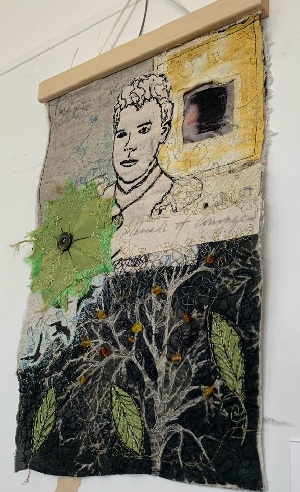
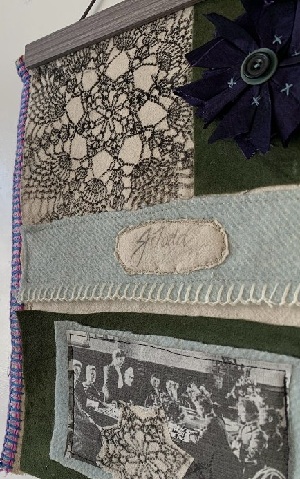
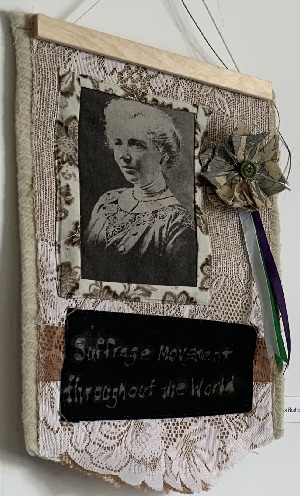
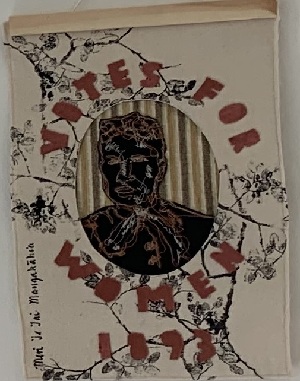
Our second event took place the next day, Saturday 20th September at a mixed media workshop, hosted by the NCW Southland Branch, alongside local artists Andrea Sexton and Mary Napper. The workshop was supported by The Southland Community Education Programme.
The workshop channelled the work done to create the very successful "Suffrage in Stitches" exhibition in 2019. Here a group of local women created A4 sized hangings celebrating Southland women who signed the original petition in 1893.
The results were exhibited for public viewing at Whare Taupua, Arts Murihiku from 28 September - 11 October. Some of the works are seen in the attached photographs:
 |
 |
 |
 |
By
Margaret G. Cook
Secretary, NCWNZ Southland Branch
The Whanganui branch of National Council of Women of New Zealand held their annual Wynne Costley Research Essay Scholarship evening recently. Year 10 students from Nga Tawa were welcomed this year, joining students from Whanganui High and Whanganui Collegiate, the two schools which have regularly supported the scholarship since its inception.
There were twenty-nine entries and the essay subjects covered women from all ages and professions. The assessors were very impressed with all the students’ choices and gave out two special prizes:
- Rose Schmidt of Collegiate for her essay on local woman, Penny de Jongh, and
- Chloe Andrews of Whanganui High for her choice of Sidney Koreneff.
The Overall Winner, Dylan Tennant from Collegiate, wrote an excellent essay on Mabel Howard.
Mary-ann Ewing, who assessed the essays spoke about the wide range of women chosen by students this year. She told us that the students had researched and written about many different women: Māori and Pākehā, young and old, contemporary and historical -- but all the women were brave, dedicated and humble about their personal role in improving the lives of others.
Sally Patrick, currently Project Archivist at Nga Tawa Diocesan School, was the guest speaker. She spoke about the process of researching subjects, the importance of archival records and noted that the ability to read handwritten information is fast becoming a lost skill. She also congratulated the students on choosing to research women whose contribution to the country and society is largely overlooked and all but forgotten.
NCWNZ Action Hubs
Attention: Action Hubs and Branches.
Are you planning your upcoming meetings? The Parliamentary Watch Committee (PWC) would be delighted to tailor a presentation on NCWNZ submissions to suit your agenda and engage your members. Possible topics include:
- How a bill becomes law—and how we can have our say
- The NCWNZ submissions process —and Action Hub and Branch involvement
- What makes a quality submission—for bills and other proposals
If you're interested, please contact Julie Thomas, PWC Convenor, at [email protected].
Resources to share in meetings and with your networks
Please share the information about the results of the 2025 Gender Attitudes Survey - you can find the NCWNZ press release here - and our YouTube video of the launch here. There is much to discuss!

Renee B. Adams of the University of Oxford and European Corporate Governance Institute has written a short paper on the need to invest in women's art and women artists. Her paper is available to download for free. Here is the abstract:
"I use data on values to challenge the belief that women produce art of lower value. Using data on individuals' occupations in the European Social Survey (ESS) and OLS regressions, I show that women are more likely to be artists in more gender-equal countries. This evidence is consistent with greater barriers to artistic careers for women than men. Using data on Schwartz human values in the ESS, I then show that women artists appear more exceptional in their artistic values than men. My evidence highlights the dangers of equating price with value and reinforces the benefits of continuing to invest in women's art and women artists."
Adams, Renée B., The Value(s) of Women Artists (September 24, 2025). Available at SSRN: https://ssrn.com/abstract=5553622
Lindsay Hawthorne and Patricia Forrest, "It's Time to Ban Junk Science Theory in Family Court: Parental Alienation Syndrome" is not an acceptable defense for child sexual abuse," Commentary, Crime & Law (October 24, 2025), Women's eNews.
Due to the reliance on a debunked junk science theory called Parental Alienation Syndrome, family courts have often required visitation with parents who have sexually abused their children, sometimes even granting the unsafe parent shared or sole custody. It’s time for family courts to halt this harmful precedent. For the safety of children, and to ensure the child has a pathway to heal, judges must reject the junk science theory on which these decisions are based and stop requiring shared custody or visitation with parents who children say have sexually abused them.
Nina-Simone Edwards of the Georgetown University Law Center has written a paper on cybersecurity policy that bases its arguments on feminist legal theories. Here's the abstract:
Cybersecurity policy has long focused on strengthening infrastructure and mitigating technical risks. These efforts remain essential, but they are no longer sufficient: As the digital landscape evolves, so too must our understanding of where vulnerability resides. This report describes human vulnerabilities—stemming from a lack of digital access, skills, and literacy—that must be recognized as core cybersecurity concerns, not peripheral issues. Drawing on feminist legal theories, this report develops a conceptual framework for understanding vulnerability. It then examines and critiques traditional narratives and assumptions that have hindered effective policy responses before using testimonial data to highlight the importance of cybersecurity policy initiatives that recognize the connection between human and cybersecurity vulnerabilities. The report then proposes concrete policy solutions, informed by the groundwork laid by previous efforts related to addressing the digital divide while underscoring the urgent need for more effective, equity-driven approaches. At the intersection of human and cybersecurity vulnerabilities lies the opportunity to build a more equitable digital future—one where all users are empowered to engage securely and confidently.
Download the paper here: Edwards, Nina-Simone, "Digital Gaps, Cyber Threats: Designing Policies to Keep People Safe Online" (September 10, 2025). New America Publication, Available at https://ssrn.com/abstract=5660170
or http://dx.doi.org/10.2139/ssrn.5660170
Readings to consider
Lianne Dalziel CNZM, a former MP and former mayor of Christchurch, wrote a powerful op-ed published in Newsroom (14 May 2025). She explained why she joined the People's Select Committee on Pay Equity and stated, "There are legitimate questions to ask and debate in the context of legislative reform. But ramming through a retrospective repeal without any warning is simply unacceptable.” Read her statement here:
https://newsroom.co.nz/2025/05/14/ramming-through-retrospective-repeal-of-pay-equity-is-unacceptable/

Myrna Dawson (University of Guelph) and Debra M. Haak (Queen's University, Faculty of Law), "Treating Male Violence Against Women and Girls as Hate in Canada," Canadian Journal of Women and the Law (forthcoming). Download the paper at https://papers.ssrn.com/sol3/papers.cfm?abstract_id=5528678
Abstract: Some incidents of male violence against women and girls (MVAWG) could be recognized as sex-motivated hate crimes. Often, however, crimes of male violence are neither treated as hate crimes nor reported as sex-motivated. This article examines sex-motivated hate, and the violence that results from sex-motivated hate in Canada, to explore its absolute and relative visibility. Sex is included as a targeted social group in hate crime laws in Canada. We consider whether and how sex is reflected in crime reporting data, sentencing, and public discourse. We demonstrate that violence motivated by sex is rarely identified as hate crime by legal actors tasked with enforcing and implementing criminal offence and sentencing provisions. We conclude by providing steps that could be taken to ensure sex-motivated hate, including sex-motivated violence, is recognized as a form of hate like other more commonly recognized targeted groups going forward.
Jungmin Lee (Seoul National University) and Yoonsoo Park (Sookmyung Women's University), "Does Single-Sex Schooling Benefit All?" (16 Sept 2025). Download the paper at https://papers.ssrn.com/sol3/papers.cfm?abstract_id=5494569
Abstract: We examine the impact of single-sex schooling on student outcomes, including standardized test scores, perceptions of academic environments, and intended college majors. To address self-selection into single-sex schools, we use data on students’ school preferences revealed through applications in a school choice program in Seoul, South Korea. We find that single-sex schooling enhances academic performance for girls but not for boys. Although single-sex schools create a more positive academic environment for girls, they also reduce female interest in STEM majors, while increasing STEM interest among boys—potentially widening the gender gap in STEM fields. Our findings highlight the importance of considering both cognitive and non-cognitive outcomes, as well as the potential for gender differences.
87%.
That’s the number of peace talks that took place in 2024 without a single woman at the table.
Women’s leadership is not and should not be symbolic — it is the key to building lasting peace #ForAllWomenAndGirls.
Find out more about United Nations Secretary-General's report on #WomenPeaceSecurity: http://unwo.men/Ma9C50XfbXz
Stories to celebrate
Whanganui Awa has won an international award sponsored by the World Future Council, IUCN World Conservation Congress and the Inter-Parliamentary Union. There were 41 nominations from 21 countries for the 2025 World Future Policy Awards which celebrate policies that enable a paradigm shift in the way humanity interacts with nature. The 2017 Te Awa Tupua Act (Whanganui River Claims Settlement Act), which recognises the river as a living entity with its own rights, claimed the Global Impact Award. The citation described the act as “a transformation from a Western legal system that separates people from nature to an indigenous law where people are part of nature and carry a duty to care for it.” The winners were chosen by an independent jury of international experts and included policies passed in Uganda, Bhutan and Austria.

Distinguished Professor Jacinta Ruru MNZM FRSNZ (Raukawa, Ngāti Ranginui), of Ōtākou Whakaihu Waka – the University of Otago, has been awarded the Humanities Aronui Medal for internationally acclaimed research on how colonial legal systems ought to recognise Indigenous peoples’ interests in land and water. She has advanced innovative options including granting legal personhood to natural features such as mountains and rivers. She also successfully campaigned for inclusion of tikanga Māori into the teaching at all New Zealand law schools. Read more about Jacinta's prize here: https://www.royalsociety.org.nz/what-we-do/medals-and-awards/research-honours/2025-rha/2025-humanities-aronui-medal
The Women Deliver 2026 Conference (WD2026) will take place from 27–30 April 2026. The conference will be regionally hosted for the first time — by the Oceanic Pacific — in Narrm (Melbourne), Australia, on the unceded lands of the Wurundjeri Woi Wurrung Peoples of the Kulin Nation. Read more about this conference here - and apply for exhibition space soon.
Dates to note for November-December 2025
10 Nov - World Science Day for Peace and Development
18 Nov - World Day for the Prevention of and Healing from Child Sexual Exploitation, Abuse and Violence
20 Nov - World Children's Day
25 Nov - International Day for the Elimination of Violence against Women
2 Dec - International Day for the Abolition of Slavery
10 Dec - UN Human Rights Day
18 Dec - International Migrants Day
25-26 Dec - NZ Public Holiday for Christmas and Boxing Day
27 Dec - International Day of Epidemic Preparedness
Quotation to ponder
"Take care of our children. Take care of what they hear. Take care of what they see. For how the children grow, so will the shape of Aotearoa."
Dame Whina Cooper (9 December 1895 – 26 March 1994);
listen to Dame Whina speaking in a 1975 oral history interview
archived at Ngā Taonga
Whakataukī to share
E tū ki te kei o te wakai kiad pakia koe e ngā ngaru o te wā.
Stand at the stern of the waka and feel the spray of the future biting at your face.
This whakatauākī comes from Te Tai Rāwhiti, from the leader Apirana Mahuika. It reminds us that leaders face the future head-on with courage and perseverance. And while it can be a daunting and lonely role, the journey by the navigator at the stern of the waka is not alone. Lean into the spray. Feel the bite of the future. Step forward with courage. (Watch the beautiful short video from Te Whare Hukahuka here.)
-=-=--=-=-
The Circular is the official newsletter of The National Council of Women of New Zealand. Archived copies are available at the National Library of New Zealand (ISSN 2815-8644).
Do you have some news to share? Please send an email to the newsletter managing editor, Randolph Hollingsworth, at [email protected].