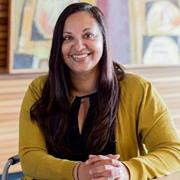
 Gail Pacheco is currently an adjunct Professor in the Faculty of Business, Economics and Law at the Auckland University of Technology and she is the Kaihautū Ōritenga Mahi Equal Employment Opportunities (EEO) Commissioner at the Te Kāhui Tika Tangata Human Rights Commission. She was invited by Eva Hartshorn-Sanders of the International Action Hub to provide her perspectives on a series of questions of importance to our members.
What are two significant issues facing women and girls in Aotearoa New Zealand?
The road to gender equality is long and uneven. In Aotearoa New Zealand we have made good progress in some areas, for example the increasingly levels of labour market participation and educational success of women and girls. There, of course, remain many pressing issues. It is worth noting that these challenges may also be magnified when they intersect with other aspects of identity, such as ethnicity, belonging to rainbow communities, or having a disability. Two key issues are briefly described here: pay equity and Diversity, Equity, and Inclusion (DEI) initiatives.
Pay Equity
Currently access to pay equity is an issue of significance. As Kiwis we believe in giving everyone a fair go. That includes making sure people working in jobs dominated by women are paid fairly and valued for their work.
Pay equity claims seek to address longstanding inequalities between men and women performing work of equal value. Recent legislative changes are concerning for several reasons. It has now become more difficult to access pay equity remedies as the announced changes limited the scope and set higher thresholds. Further, progress on existing claims have been halted, and these are claims that thousands of people have advocated for and worked on in good faith.
Introducing these changes under urgency has removed the opportunity for meaningful consultation with affected groups. Moreover, the changes conflict with the Government’s obligations under Te Tiriti o Waitangi, which include taking active steps to reduce pay disparities and promote equitable outcomes for Māori.
This is why I support Marilyn Waring’s creation of a People’s Select Committee, by bringing together ten former Members of Parliament from across the political spectrum. I encourage all people interested in the topic to make a submission, whether that is on the changes as a whole or simply elements of it that you have particular interest in. The link to make a submission is https://www.payequity.org.nz/.
Protecting and Advancing DEI Initiatives
Diversity, Equity, and Inclusion (DEI) is about ensuring that every person — regardless of ethnicity, gender, sexuality, disability, or socioeconomic background — has a fair chance to thrive in the workplace. DEI helps guard against bias, discrimination and limited access to networks, which continue to affect many. DEI upholds human rights, fairness and dignity.
Despite progress, DEI is under pressure – and this is occurring in both the global and domestic context. Here in New Zealand, we’ve seen moves that threaten past gains — from changes to the Equal Pay Act to disbanding Te Aka Whai Ora which was established to address health inequities experienced by Māori. There are also currently proposed changes to our Public Service Act that involve removing DEI. From my perspective, these policy shifts are part of a wider landscape where there is a rollback of equity commitments.
There are a number of false narratives in this space. One significant and common myth is that DEI undermines meritocracy. The truth is that removing unfair barriers is what enables true meritocracy.
DEI will also make our society and economy stronger. With Māori, Pacific, and Asian populations projected to make up nearly 60% of our workforce by 2043, inclusive workplaces will be essential to productivity and resilience.
I encourage everyone to ensure that DEI initiatives where they work are continued and strengthened and that people around you understand that DEI is a crucial component of merit-based appointments.
How can data help us to address these wicked problems?
Data is very important; it can expose patterns of human rights issues and help us understand human rights issues at a systemic and not just an individual level. It also helps us measure improvements in human rights and whether the work we are undertaking has impact.
Look at the gender pay gap, many organisations have made an intentional and concerted effort to measure, to understand and reduce the gap. Data has been pivotal in this space. At the organisational level, it helps to understand whether gaps are occurring in like for like roles, or whether the key reason for an organisational gender pay gap is systemic in nature – e.g. women are not progressing to the more senior roles within the organisation. Once an organisation understands the key drivers behind their gender pay gap, they can develop plans to help reduce it, and then can use data to measure the impact of their policies.
The importance of data is recognised at the international level, for example the UN Committee on the Elimination of all forms of Discrimination Against Women acknowledged the need for data to advance women’s rights in the 2024 review. The Committee recommended that we adopt measures based on systematic data collection and analysis to strengthen prevention of gender-based violence against women.
It is also worth noting that obtaining accurate data in some areas is difficult for a myriad of reasons, but this does not mean that those areas are not important for human rights advocacy. For example, accessing statistics on gender-based violence, family violence and data related to human trafficking are areas where there is likely underreporting and difficulties in collecting accurate data.
What other key steps do you think we need to take – particularly from the government and business perspective?
I would love to see our government use human rights as an underlying driver in decision making. Upholding human rights should not be an afterthought or reserved for specific projects but should be woven into an all of government approach. At an international level there are various human rights treaties that we are not yet party to. For example, it would be great to see the government ratify ILO 190 which recognises the right to a world of work free from violence and harassment, including gender-based violence. It could be a powerful tool to protect women — especially in vulnerable jobs — ensuring safety, dignity, and equality in the workplace.
For businesses, ideally, they would take a similar approach. I would encourage them to understand that businesses have human rights obligations and learn about these. At a pragmatic level I would suggest that businesses, particularly small businesses, look at one or two specific initiatives that they can be involved in to proactively uphold human rights. Many businesses are doing this already even if they do not think of it as human rights work or use that framing. This may be, for example, measuring and reporting gender and ethnic pay gaps or undertaking modern slavery risk assessments.
How would you like to work with women's organisations while in your role?
There are many effective and strong women’s organisations in our country (many of which I have already spoken to in my first 9 months in the role), and I look forward to strengthening my collaboration with them. This is particularly important at times when many organisations have constrained resourcing.
I am particularly interested in working with women’s organisations that are taking an intersectional approach to women’s rights. The right of women and girls do not stand alone but are connected to our other human rights and our many other identities. Human rights are deeply interconnected and woven together, and we must have this in mind in our advocacy work.
What do you like to do when not working, and what is one interesting fact about you that people may not know?
When not working, I enjoy spending time with the kids – although not so sure they feel the same way all the time, given they are teenagers now (aged 15 and 18). I am an avid gym goer, and am regularly up for a jog at 6am. And for the interesting fact, I enjoy watching most sports and am a loyal fan of the NZ Warriors – have been a season ticket holder for more than 20 years – so, I will have to end with Up The Wahs!
To read more articles from The Circular (July-August 2025) issue 653, click on the tag below.