On Friday, 15 August 2025, NCWNZ members had the pleasure of attending the Inside the Glass Cage: Online Misogyny in Aotearoa New Zealand exhibition at Te Auaha Gallery in Wellington. This was a collaboration between researchers Tracey Nicholls, Suze Wilson, Sarah Riley and Rochelle Stewart-Withers, with artist Richard Brown, to show the results of the Marsden-funded research project that is in its first year.

The exhibition offered visitors an immersive experience showing the impact of online misogyny. It featured three ‘glass cages’ – seven Perspex walls and one open wall so that you can walk inside. Each cage had quotes from interviews with women politicians and journalists, written on the walls.
Inside the Glass Cage confronted its visitors with the violence women face online, and in particular, what impact that has on them physically and emotionally. Too often rendered invisible or dismissed as insignificant, online violence is deeply rooted in the real world, undeniably affecting the daily lives of its victims as this exhibition shows. Increasingly, the digital sphere is providing a fertile ground for hate and violence.
Women in the public sphere have had to develop strategies to resist those who wish to silence them. Online misogyny, by functioning as a ‘glass cage’ tries to limit women action by affecting their credibility and self-confidence. This issue extends beyond the impacted women themselves to impact the whole society through limiting the diversity of voices in public spaces.
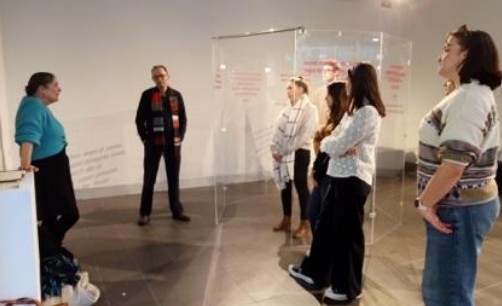
Inside the Glass Cage places women’s experiences at the centre of the exhibition. Beyond simply presenting data, the exhibition offers a striking and powerful interpretation of the lived reality faced by many and invites the visitor to feel the emotions and empathise with them. It serves as a reminder of the importance of neither overlooking violence invisible nor downplaying it, regardless of the form it takes.
We thank Dr Tracey Nicholls for her fascinating and insightful explanations, and the research team for their invitation. We wish all of them a lot of success in their project. In the next phases of the research, they will be talking to more participants. If you are interested in knowing more about the project or participating, please contact Dr Tracey Nicholls at [email protected].
By
Mathilde Jaulin and Manon Valls-Hazarian, NCWNZ interns
To read more articles from The Circular (July-August 2025) issue 653, click on the tag below.